 |
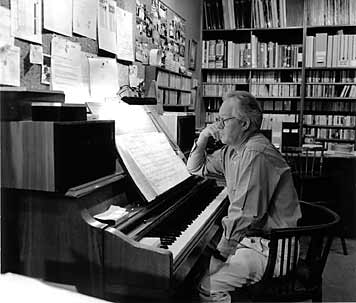
BRIAN
BENNETT was born in London in 1940 and by the late 1950s was one
of the most sought-after percussionists around.
He was drummer
in residence at the legendary ‘2 i s’ in Soho and a regular
on Jack Good's ground breaking TV show Oh Boy.
In 1961,
he was invited to join Cliff Richard and The Shadows and wrote many of
the hit songs from the films, including Summer Holiday (for which
he won his first Ivor Novello award), Wonderful Life and Finders
Keepers.
In the 1970s,
he became Cliff Richard's musical director and formed The Brian Bennett
Orchestra touring the world including the first concerts to be staged
in Russia.
By the mid
1970s, Brian was in demand as an arranger, conductor and record producer
and had already started composing for film and television.

During the
1980s, he was awarded his second Novello award (for 25 years services
to music) and was busy writing and recording music for a wide range of
programmes including Dallas, Knotts Landing, Pulaski, The Royal Wedding,
BBC Golf theme, The Sweeney, Dennis Hopper's film The American
Way and Ellen Barkin and David MacCallum's Terminal Choice.
 In
1990, he won his third Ivor Novello award for Best Score For A Television
Series (The Ruth Rendell Mysteries). In
1990, he won his third Ivor Novello award for Best Score For A Television
Series (The Ruth Rendell Mysteries).
From the
1990s to 2000, he was in demand more than ever, recent commissions including
the long-running series The Knock, Nomads of the Wind, Global Sunrise,
The Harpist, David Jason In His Element, Living Britain and Dirty
Work.
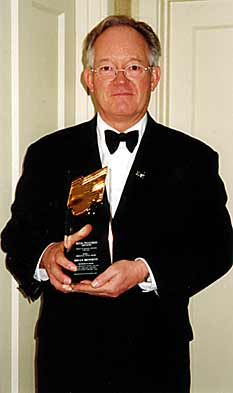
In
2001, Brian
was the proud recipient of the Gold
Badge Award given by the British Academy of Composers &
Songwriters Society. He also
won the Royal Television Society Craft & Design Awards 2000/2001 for
Best Original Title Music for Murder In Mind
(See pic, right).
He
lives and works in Hertfordshire where he runs his own recording studio
and record label.
|
Sir
Tim Rice writes...
Brian
Bennett has been a force in British music for over 40 years. He
was in the forefront of the early days of rock 'n' roll (or to be
strictly accurate, at the back, because he was a drummer), part
of both the innovative and influential '2 i s' coffee bar scene
in Soho, and of another equally important institution of the late
Fifties, Jack Good's immortal television series 'Oh Boy!'. On TV
and on tour he played with many of the American musical giants of
the time, such as Eddie Cochran, Conway Twitty and Gene Vincent,
and also with many of the original British rockers, including one
of the first and best, Marty Wilde.
Becoming
a permanent member of Marty's band, the Wildcats, Brian first hit
the charts as a member of the not unrelated Krew-Kats with 'Trambone'
in 1961. This was the year in which he was invited to step into
the Shadows, already Britain's leading pop group, and with Brian
on the drumstool, the Shadows scaled new heights as performers and
songwriters, both with and without Cliff Richard. Brian wrote many
of their greatest hits, including (with Bruce Welch) one of the
most performed songs of the last century - 'Summer Holiday'. Other
BB-written hits at this time included 'I Could Easily Fall' and
'The Rise and Fall Of Flingel Bunt'.
In
the later part of the Sixties, Brian was more often to be found
directing and conducting an orchestra than on Shadow duty, becoming
one of the country's most in-demand arrangers, working as musical
director for Cliff Richard, Demis Roussos and many other artists.
His orchestra was the first rock aggregation to play in the Soviet
Union, way before the more-publicised trips by subsequent rock stars.
The Shadows had a magnificent late Seventies renaissance, which
made Brian once again a star performer all over the world, but he
never abandoned his solo career. All through the Eighties and Nineties
he wrote and produced for films and television, winning both accolades
and awards (such as the Ivor Novello for his Ruth Rendell scores).
His recent work is currently to be heard via 'Murder In Mind' on
BBC1, while many of his older compositions, we are delighted to
say, show no signs of going away.
(From
the British Academy of Composers & Songwriters 27th Gold Badge
awards, October 2001)
|
|
|
